Wu Lab

The research lab of Yu-Chien Wu, MD, PhD, is actively investigating a wide range of radiology and imaging topics. Dr. Wu is particularly focused on studying diffusion physics in biologic system using diffusion MRI.

members of the wu lab

Wu Lab featured in national IU commercial

Expertise

The Wu Lab is a national leader in neuroscience expertise. From working on studies like the CARE Consortium, the world's most comprehensive concussion study, to uncovering early diagnosis treatments for Alzheimer's disease, the Wu Lab is a pioneering hub for research excellence at IU School of Medicine and across the country.


Get Connected

Stay up to date on the latest research by the Wu Lab and reach out to current team members.

14 countries represented
$11 million in grant funding
200+ publications
Research Topics
Images of brain scans for Alzheimer's.

Alzheimer's disease

With current treatments only managing symptoms, research is needed to address early diagnosis and intervention.

Imagings of brain scans for animials.

Animal Imaging

In vivo assessments on a mouse model find disruptions in microstructural integrity and neurite organization.

Images of brain scans for concussion.

Sport-Related Concussion

The relationship between blood-based neural biomarkers and white matter neuroimaging in collegiate athletes.

Images of brain scans.

Human Imaging

The lab highlights the growing impact of computational methods, combined imaging techniques, and animal models in advancing neuroscience research.

Images of brain scans for TBI.

Traumatic Brain Injury (TBI)

The lab addresses the sensitivity issues of conventional medical imaging techniques in detecting mild traumatic brain injury (mTBI) by utilizing hybrid diffusion imaging (HYDI).

Research Funding

Research collaborations are pivotal in advancing research within the Wu Lab. These partnerships help foster synergy, pooling diverse expertise and resources to tackle complex challenges. From access to specialized equipment, funding, and data, to amplifying research capabilities — shared knowledge accelerates innovation, refining diagnostic techniques and potential treatment strategies.

Ultimately, partnerships amplify a lab's impact, driving transformative progress in neuroscience.

Salman Shahid (left) and Yu-Chien Wu (right) sitting on a bench smiling at the camera. A small tree is in the background.

Wu Lab

  • R01 AGAG083951, NIH-NIA, Wu (PI), 2023-2028
    • Assessing Diffusion MRI Metrics for Detecting Changes of Synaptic Density in Alzheimer's Disease
  • R01 NS112303-01, NIH-NINDS, Wu (PI), 2020-2026
    • Comprehensive White-Matter Microstructure-Informed Analytical Methods to Elucidate Neurobiological Mechanisms of Sports-Related Concussion

Collaborative

  • U54AG054345,  NIH-NIA, Bruce Lamb (PI), Wu (Co-I), 2022-2027
    • IU/JAX/PITT MODEL-AD Center
  • P30 AG072976, NIH, Saykin (PI), Wu (Co-I), 2021-2026
    •  Indiana Alzheimer Disease Research Center
  • R01 DA059321, NIH, Radhakrishnan (PI), Wu (Co-I), 2023-2026
    •  Multimodal Fetal and Placental Imaging and Biomarkers of Clinical Outcomes in Opioid Use Disorder
  • W81XWH1820047 and HU001-18-2008, U.S. Army MTEC & NCAA, McAllister, IUSM (PI), Broglio, University of Michigan (PI), McCrea, Medical College of Wisconsin (PI), Wu (Co-I), 2021-2026
    •  Characterizing Potential Chronic Brain Health Effects of Concussion and Repetitive Head Impact Exposure: The CARE-SALTOS Integrated (CSI) Study
  • R01 NS128961, NIH, Dams-O’Connor, Mount Saini (PI) Hammond (Site-PI), Wu (Co-I), 2022-2027
    • Clinical & biological signatures of post-traumatic neurodegeneration: Leveraging the TBI Model Systems of Care to accelerate in vivo diagnosis of the late effects of TBI (LETBI)
  • R01 CA290435, NIH, Kim, University of Alabama (PI), Wu (Co-I), 2024-2029
    • DCE-MRI guided Neoadjuvant Chemotherapy for Borderline Resectable Pancreatic Cancer.
  • R01 NS135776, NIH-NIDS, Meier, Medical College Wisconsin (PI), Wu (Co-I), 2024-2027
    • The role of cytomegalovirus in the physiological and clinical effects of concussion.

Wu Lab

  • R01 NS112303-03S1, NIH-NINDS-NIA, Wu (PI), 2022-2025
    • Elucidating Pathophysiological Mechanisms of Alzheimer's Disease Using White-Matter Microstructure-Informed Subject-Specific Analytical Methods
  • S10 OD036259, NIH-OD, Wu (PI) 2025-2026
    • High Performance Gradient System for Advanced MRI Neuroimaging
  • R01 AG053993, NIH-NIA, Wu (PI), 2016-2024
    • Modeling Axonal Density and Inflammation-Associated Cellularity in Alzheimer's Disease Using Hybrid Diffusion Imaging 
  • R21AG068962, NIH-R21 (PI: Tong, Purdue University), Wu (Site-PI), 2021-2024
    • Image-Based Modeling of Biomechanical Factors for Risk Assessment of Developing Periventricular White Matter Hyperintensities
  • 2R44AG060861-02, NINDS-ADM Diagnostics, Inc. (PI: Matthews at ADM Diagnostics, Inc.), 2022-2024
    • Multi-modal Machine Learning Detection and Tracking of Traumatic Brain Injury Neurodegeneration and Its Differentiation from Alzheimer's Disease
  • Identifying Microstructural Imaging Biomarkers that Predict Post-Traumatic Headache, Indiana State Department of Health, Wu (PI), 2021-2023
  • Tau propagation and white matter degeneration in early stages of Alzheimer’s disease, IADC, Pilot Project, Wu (PI), 2020-2021
  • Research Contract, Siemens, Wu (PI), 2018-2021
    • Diffusion MRI
  • Combing the perfusion, function and structure matrices of the brain to assess the spectrum of Alzheimer’s disease, CTSI-IADC Pilot, Tong (PI), Wu (Site-PI), 2020-2022
  • R01HD096800, NIH, Sadhasivam (PI), Wu (Co-I), 2018-2020
    • Effects of opioid use disorder in pregnancy on long-term maternal and child outcomes
  • CTR, CTSI, Wu (PI), 2016-2018
    • Microstructure Modulated White Matter Connectivity for Mild Traumatic Brain Injury
  • R21 NS075791, NIH/NINDS-Dartmouth, McAllister & Wu (MPI), 2011-2015
    • HYBRID Diffusion Imaging to Detect Acute White Matter Injury After Mild TBI 
  • High Angular Resolution Diffusion Imaging(HARDI) with novel HYPR image reconstruction, Dartmouth SYNERGY, Wu (PI), 2012-2015
  • Hybrid Diffusion Imaging (HYDI) of the Kidney, IUPUI-RITDP,  Wu (PI), 2015-2016
  • Microstructure Imaging of the Human Brain with TBI, IUPUI-ITDP, Wu (PI), 2015-2016
  • Measuring Axonal Diameters and Density with a Novel ActiveAx and Fast RSA-EPI Sequence, IADC, Pilot Project, Wu (PI), 2014-2016
  • R01 AG053993-01, NIA, Wu (PI), 2016 – 2021
    • Modeling Axonal Density and Inflammation-Associated Cellularity in Alzheimer’s Disease Using Hybrid Diffusion Imaging

Collaborative

  • R01, NIH-NIA, Lasagna-Reeves (PI), Wu (Co-I), 2023-2025
    • CAA, Tau and Neurodegeneration
  • R01AG061788, NIH, Risacher (PI), Wu (Co-I), 2019-2024
    • Multi-Domain Sensory Measures as Biomarkers of Alzheimer's Disease in Preclinical and Prodromal Stages
  • R03, NIH,Radhakrishnan (PI), Wu (Co-I), 2023-2024
    • Neuroimaging in Pregnancy to Assess Effects of Opioid Use Disorder
  • R01AG022304-15S1, NIH-NIA Rao, Cleveland Clinic (PI), Lamb, IUSM (PI), Wu (Co-I), 2021-2023
    • Immune Mechanisms Underlying the Neuroprotective Effects of Physical Activity in Human and Mouse Models of Genetic Risk for Alzheimer’s Disease
  • R01 AG019771, NIH, Saykin (PI), Wu (Co-I), 2017-2023
    • Memory Circuitry in MCI and Early Alzheimer’s Disease Prodrome: Molecular Drivers
  • R56 AG047992-07A1, NIH, Newhouse, Vanderbilt University (PI), Saykin (Site-PI), Wu (Co-I), 2022-2023
    • Long-Term Nicotine Treatment of Mild Cognitive Impairment
  • U01 AG072177, NIH-NIA, Saykin (PI), Wu (Co-I), 2021-2022
    • Korean Brain Aging Study, Longitudinal Endophenotypes and Systems Biology
  • R01 AG047992, NIH, Newhouse (PI), Saykin (Site-PI), Wu (Co-I), 2015-2022
    • Long-Term Nicotine Treatment of Mild Cognitive Impairment 
  • R01 AG052439, NIH, Clark (PI), Wu (Co-I), 2017-2022
    • MIND Food and Speed of Processing Training in Older Adults with Low Education, The MINDSpeed Alzheimer’s Disease Prevention Pilot Trail
  • R21AG066135, NIH-NIA, Yan (PI), Wu (Co-I), 2019-2022
    • Gene Co-expression Underlying the Connectomic Alterations in Alzheimer’s Disease
  • U01 MH109977, NIH, Shenton, Harvard Medical School (PI), Breier (Site-PI), Wu (Co-I), 2016-2021
    • Human Connectome Project for Early Psychosis
  • W81XWH-14-2-0151, DoD+NCAA, McAllister (PI), Wu (Co-I), 2018-2021
    • Concussion Assessment, Research and Education Consortium for sport-related concussion and military personnel
  • R01 EB022574, NIH, Shen (PI), Saykin (Site-PI), Wu (Co-I), 2016-2021
    • Integrative Bioinformatics Approaches to Human Brain Genomics and Connectomics
  • P30 AG010133, NIH, Saykin (PI), Wu (Co-I), 2011-2021
    • Indiana Alzheimer Disease Center
  • ARRS Scholarship, ARRS, Radhakrishnan (PI), Wu (Co-I), 2018-2020
    • Predicting neurodevelopmental outcomes in neonatal abstinence syndrome
  • Improving functional ability in chronic TBI with intensive rehabilitation robotic gait training (PI: Massie), Indiana Spinal Cord & Traumatic Brain Injury Research Fund, Wu (Co-I), 2017-2019
  • Data Research/Pilot Study Project, IU-Health, Sadhasivam (PI), Wu (Co-I), 2018-2019
    • Effects of an 8-day advanced meditation, Samyama on physical, psychological and spiritual wellbeing, and associated neural mechanisms
  • UH3TR000955-S1, NIH, Breier (PI), Wu (Co-I), 2016-2018
    • The Efficacy and Safety of a Selective Estrogen Receptor Beta agonist (LY500307) for Negative Symptoms and Cognitive Impairment Associated with Schizophrenia
  • R21 AG051932, NIH, Callahan (PI), Wu (Co-I), 2016-2018
    • Angiogenesis and Alzheimer’s Disease
  • W81XWH-14-2-0151, NCAA-DoD, McAllister (PI), Wu (Co-I), 2014-2018
    • Concussion Assessment, Research and Education Consortium (CARE)
  • Advancing the Understanding of Biomechanical Parameters Associated with Mild Traumatic Brain Injury, NOCSAE, McAllister (PI), Wu (Co-I), 2011-2013
  • R01 MH091100-A1, NIH, Holzheimer (PI), Wu (Co-I), 2011-2013
    • Investigating Biomarkers of TRD Using Neuroimaging
  • Advanced MRI Evaluation of Cerebral Blood Flow and Brain Connectivity Biomarkers in Adolescent Subacute Sports-related Concussion, Ninesigma, Inc., McDonald (PI), Wu (Co-I), 2014-2015
  • UH3TR000955, NIH, Breier (PI), Wu (Co-I), 2014-2015
    • The Efficacy and Safety of a Selective Estrogen Receptor Beta agonist (LY500307) for Negative Symptoms and Cognitive Impairment Associated with Schizophrenia
  • Dissection of Cholestatic Itch in Primary Biliary Cirrhosis, Intercept Pharmaceuticals, Chalasani (PI), Wu (Co-I), 2015-2017
  • Evaluation of Resting State fMRI in Neonates with Hypoxic-Ischemic Injury, radPDT,  Kralik (PI), Wu (Co-I), 2016-2017

Need help getting that S10 grant? Talk to Dr. Wu!

news & publications

Dr. Wu wins Radiology Faculty Mentorship Award

Yu-Chien Wu, MD, PhD, was recognized with the 2024 Radiology Faculty Mentorship Award.

The award was established to recognize faculty mentors in the Department of Radiology and Imaging Sciences who exemplify excellence as they support and contribute to the career development and advancement of other faculty members and learners (students, residents, fellows and postdocs) in the areas of research, education, service and/or clinical practice. 

Alterations of brain microstructures in mouse model

Images of six brain scans over black background.

Read Article

Differential vulnerability of hippocampal microstructure

Two images of brain scans.

View Abstract

Understanding the role of amyloid to cerebral microvasculature in AD

Images of brain scans in grays, blues and greens over black background.

View Abstract

Role of neurochemistry in amyloid pathology

Image of graph

View Abstract

Pain-Related White-Matter Changes Following Mild Traumatic Brain Injury: A Longitudinal Diffusion Tensor Imaging Pilot Study

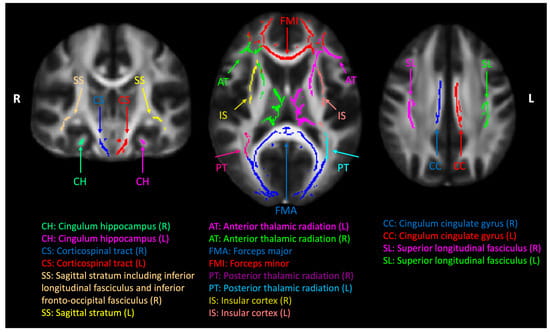
Cerebral white-matter tract regions of interest (ROIs). A common white-matter skeleton was first generated by the tract-based spatial statics (TBSS) toolbox in the FMRIB Software Library (FSL) using normalized diffusion tensor imaging (DTI) factional anisotropy maps from all the subjects. The white-matter skeleton was intercepted with Johns Hopkins University (JHU) white-matter tract atlas, and eighteen ROIs were used in this study.

View Abstract