The DeVault Otologic Research Laboratory, within the Department of Otolaryngology–Head and Neck Surgery at Indiana University School of Medicine, carries out basic and clinical research in children and adults who wear Hearing Aids (HAs) and/or Cochlear Implants (CIs). Guided by Irina Castellanos, PhD, the DeVault Otologic Research Laboratory seeks to understand critical quality-of-life outcomes following hearing loss and amplification/implantation.

Join our research
If you would like to participate in research at the DeVault Otologic Research Lab, please enroll in our research recruitment database.
Innovative Approach
We adopt a whole-person approach to studying children and adults who use HAs/CIs, and our areas of focus include:
- Cognition
- Emotional and behavioral control
- Language learning
- Motor functioning
- Neural processing
- Social interactions
- Stress and coping
Interdisciplinary Backgrounds
Our team has diverse healthcare backgrounds, gaining knowledge from otology, developmental and pediatric psychology, cognitive hearing sciences, neuroscience and linguistics.
What to Expect
Participants play a variety of engaging games and activities. Depending on the project, a testing visit can last between one and three hours and can be coordinate with your clinical hospital appointments. There are also opportunities to participate in our studies from your home.
Your Time is Valuable
Participants are compensation for their time and travel. If you live more than 100 miles away, we can also arrange nearby hotel accommodations.
Discoveries and Insights
Findings by investigators of the DeVault Otologic Research Laboratory demonstrate that cochlear implants, while providing access to sound and the ability to develop speech and language for most users, do not provide the same benefit to all users, and the variability observed in speech perception and spoken language outcomes cannot be completely explained by device type, age of implantation or communication mode. For the past two decades, the DeVault Otologic Research Laboratory has focused on finding an explanation for these observed individual differences. Explore the DeVault Otologic Research Laboratory’s active grants and recent publications.
Researchers at the DeVault Otologic Research Laboratory have developed several tests of language, behavior, neurocognitive functioning, and family functioning. Explore testing materials available to clinical providers and the scientific community.
450+
peer-reviewed journal articles published
30+
years conducting research and connecting with families
1,000+
research participants and their families
History
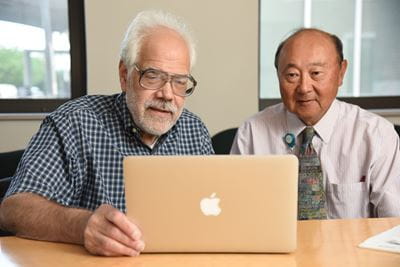 An early pioneer in the field of cochlear implant surgery, Richard T. Miyamoto, MD, FACS, FAAP, chair of the Department of Otolaryngology—Head and Neck Surgery at Indiana University School of Medicine from 1987–2014, was instrumental in the conception and establishment of the DeVault Otologic Research Laboratory. Under his leadership, a core group of multi-disciplinary researchers was assembled to study speech perception, speech production, and language development in children with cochlear implants. This group included Karen-Iler Kirk, PhD, Mary Jo Osberger, PhD, David Pisoni, PhD, and Mario Svirsky, PhD.
Named for its principal early benefactor, Virgil T. DeVault, MD (1901–2000), a native Hoosier and alumnus of Indiana University (BS, 1927; MD, 1929), the DeVault Lab continues to be a leader in advanced multi-disciplinary research with children and adults who are deaf or hard of hearing.
In September 1999, Philip F. and Ruth C. Holton, through their estate, made a generous gift of $6.5 million to the Department of Otolaryngology—Head and Neck Surgery at IU School of Medicine. The department is recognized nationally and internationally for its research on and treatment of profound deafness in children and adults. Philip F. and Ruth C. Holton selected the Department of Otolaryngology—Head and Neck Surgery for their endowment because of the great medical care given to Mr. Holton in the 1960s. Through the Holton’s generosity, $3.5 million was used to establish the Holton Otologic Research Fund and $3 million was used to establish two named professorships, the Ruth C. Holton Chair in Otology and the Philip F. Holton Scholar, which are used to recruit outstanding faculty to the Department of Otolaryngology—Head and Neck Surgery.
Collaborators
The principal investigators in the DeVault Lab are currently collaborating with colleagues around the world at The University of Connecticut, Vanderbilt University, Butler University, The Ohio State University, The University of Texas at Dallas and Hannover Medical School in Germany.